Monday, October 13, 2014

On Unnatural Sex

Summa Theologica: Second Part of the Second Part (Secunda Secundæ Partis), Question 154. The parts of Lust

Articles:


11. The sin against nature

12. The order of gravity in the aforesaid sins

(Related articles 1-10 can be read at NewAdvent)

Article 11. Whether the unnatural vice is a species of lust?
____________________________________

Objection 1. It would seem that the unnatural vice is not a species of lust. For no mention of the vice against nature is made in the enumeration given above (1, Objection 1). Therefore it is not a species of lust.

Objection 2. Further, lust is contrary to virtue; and so it is comprised under vice. But the unnatural vice is comprised not under vice, but under bestiality, according to the Philosopher (Ethic. vii, 5). Therefore the unnatural vice is not a species of lust.

Objection 3. Further, lust regards acts directed to human generation, as stated above (Q. 153, A. 2): Whereas the unnatural vice concerns acts from which generation cannot follow. Therefore the unnatural vice is not a species of lust.

On the contrary, It is reckoned together with the other species of lust (2 Cor 12:21) where we read: "And have not done penance for the uncleanness, and fornication, and lasciviousness," where a gloss says: "Lasciviousness, i.e., unnatural lust."

I answer that, As stated above (A6, 9) wherever there occurs a special kind of deformity whereby the venereal act is rendered unbecoming, there is a determinate species of lust. This may occur in two ways: First, through being contrary to right reason, and this is common to all lustful vices; secondly, because, in addition, it is contrary to the natural order of the venereal act as becoming to the human race: and this is called "the unnatural vice." This may happen in several ways. First, by procuring pollution, without any copulation, for the sake of venereal pleasure: this pertains to the sin of "uncleanness" which some call "effeminacy." Secondly, by copulation with a thing of undue species, and this is called "bestiality." Thirdly, by copulation with an undue sex, male with male, or female with female, as the Apostle states (Rom 1:27): and this is called the "vice of sodomy." Fourthly, by not observing the natural manner of copulation, either as to undue means, or as to other monstrous and bestial manners of copulation.

Reply to Objection 1. There we enumerated the species of lust that are not contrary to human nature: wherefore the unnatural vice was omitted.

Reply to Objection 2. Bestiality differs from vice, for the latter is opposed to human virtue by a certain excess in the same matter as the virtue, and therefore is reducible to the same genus.

Reply to Objection 3. The lustful man intends not human generation but venereal pleasures. It is possible to have this without those acts from which human generation follows: and it is that which is sought in the unnatural vice.


Article 12. Whether the unnatural vice is the greatest sin among the species of lust?
____________________________________

Objection 1. It would seem that the unnatural vice is not the greatest sin among the species of lust. For the more a sin is contrary to charity the graver it is. Now adultery, seduction and rape which are injurious to our neighbor are seemingly more contrary to the love of our neighbor, than unnatural sins, by which no other person is injured. Therefore the unnatural sin is not the greatest among the species of lust.

Objection 2. Further, sins committed against God would seem to be the most grievous. Now sacrilege is committed directly against God, since it is injurious to the Divine worship. Therefore sacrilege is a graver sin than the unnatural vice.

Objection 3. Further, seemingly, a sin is all the more grievous according as we owe a greater love to the person against whom that sin is committed. Now the order of charity requires that a man love more those persons who are united to him—and such are those whom he defiles by incest—than persons who are not connected with him, and whom in certain cases he defiles by the unnatural vice. Therefore incest is a graver sin than the unnatural vice.

Objection 4. Further, if the unnatural vice is most grievous, the more it is against nature the graver it would seem to be. Now the sin of uncleanness or effeminacy would seem to be most contrary to nature, since it would seem especially in accord with nature that agent and patient should be distinct from one another. Hence it would follow that uncleanness is the gravest of unnatural vices. But this is not true. Therefore unnatural vices are not the most grievous among sins of lust.

On the contrary, Augustine says (De adult. conjug. [The quotation is from Cap. Adulterii xxxii, qu. 7. Cf. Augustine, De Bono Conjugali, viii.]) that "of all these," namely the sins belonging to lust, "that which is against nature is the worst."

I answer that, In every genus, worst of all is the corruption of the principle on which the rest depend. Now the principles of reason are those things that are according to nature, because reason presupposes things as determined by nature, before disposing of other things according as it is fitting. This may be observed both in speculative and in practical matters. Wherefore just as in speculative matters the most grievous and shameful error is that which is about things the knowledge of which is naturally bestowed on man, so in matters of action it is most grave and shameful to act against things as determined by nature. Therefore, since by the unnatural vices man transgresses that which has been determined by nature with regard to the use of venereal actions, it follows that in this matter this sin is gravest of all. After it comes incest, which, as stated above (A. 9), is contrary to the natural respect which we owe persons related to us.

With regard to the other species of lust they imply a transgression merely of that which is determined by right reason, on the presupposition, however, of natural principles. Now it is more against reason to make use of the venereal act not only with prejudice to the future offspring, but also so as to injure another person besides. Wherefore simple fornication, which is committed without injustice to another person, is the least grave among the species of lust. Then, it is a greater injustice to have intercourse with a woman who is subject to another's authority as regards the act of generation, than as regards merely her guardianship. Wherefore adultery is more grievous than seduction. And both of these are aggravated by the use of violence. Hence rape of a virgin is graver than seduction, and rape of a wife than adultery. And all these are aggravated by coming under the head of sacrilege, as stated above (10, ad 2).

Reply to Objection 1. Just as the ordering of right reason proceeds from man, so the order of nature is from God Himself: wherefore in sins contrary to nature, whereby the very order of nature is violated, an injury is done to God, the Author of nature. Hence Augustine says (Confess. iii, 8): "Those foul offenses that are against nature should be everywhere and at all times detested and punished, such as were those of the people of Sodom, which should all nations commit, they should all stand guilty of the same crime, by the law of God which hath not so made men that they should so abuse one another. For even that very intercourse which should be between God and us is violated, when that same nature, of which He is the Author, is polluted by the perversity of lust."

Reply to Objection 2. Vices against nature are also against God, as stated above (ad 1), and are so much more grievous than the depravity of sacrilege, as the order impressed on human nature is prior to and more firm than any subsequently established order.

Reply to Objection 3. The nature of the species is more intimately united to each individual, than any other individual is. Wherefore sins against the specific nature are more grievous.

Reply to Objection 4. Gravity of a sin depends more on the abuse of a thing than on the omission of the right use. Wherefore among sins against nature, the lowest place belongs to the sin of uncleanness, which consists in the mere omission of copulation with another. While the most grievous is the sin of bestiality, because use of the due species is not observed. Hence a gloss on Gen. 37:2, "He accused his brethren of a most wicked crime," says that "they copulated with cattle." After this comes the sin of sodomy, because use of the right sex is not observed. Lastly comes the sin of not observing the right manner of copulation, which is more grievous if the abuse regards the "vas" than if it affects the manner of copulation in respect of other circumstances.
____________________________________

From the Summa Theologica of St. Thomas Aquinas, Second and Revised Edition, 1920. Literally translated by Fathers of the English Dominican Province.

Thursday, October 9, 2014

De Ente Et Essentia

Aquinas On Being and Essence [1]
Translation © 1997 by Robert T. Miller [2) 

Prologue

A SMALL error at the outset can lead to great errors in the final conclusions, as the Philosopher says in I De Caelo et Mundo cap. 5 (271b8-13), and thus, since being and essence are the things first conceived of by the intellect, as Avicenna says in Metaphysicae I, cap. 6, in order to avoid errors arising from ignorance about these two things, we should resolve the difficulties surrounding them by explaining what the terms being and essence each signify and by showing how each may be found in various things and how each is related to the logical intentions of genus, species, and difference.

Since we ought to acquire knowledge of simple things from composite ones and come to know the prior from the posterior, in instructing beginners we should begin with what is easier, and so we shall begin with the signification of being and proceed from there to the signification of essence.

Chapter 1

As the Philosopher says in V Metaphysicae cap. 7 (1017a22-35), being has two senses. In one sense, being signifies that which is divided into the ten categories; in another sense, that which signifies the truth of propositions. The difference between these is that, in the second sense, anything can be called a being about which an affirmative proposition can be formed, even if the thing posits nothing in reality. In this way, privations and negations are called beings, as when we say that affirmation is opposed to negation, or that blindness is in the eye. But in the first sense, nothing can be called a being unless it posits something in reality, and thus in this first sense blindness and similar things are not beings.

The term essence is not taken from being in the second sense, for in this sense some things are called beings that have no essence, as is clear with privations. Rather, the term essence is taken from being in the first sense. Thus in Metaphysicae V, com. 14, the Commentator explains the cited text from Aristotle by saying that being, in the first sense, is what signifies the essence of a thing. And since, as said above, being in this sense is divided into the ten categories, essence signifies something common to all natures through which the various beings are placed in the various genera and species, as humanity is the essence of man, and so on.

Since that through which a thing is constituted in its proper genus or species is what is signified by the definition indicating what the thing is, philosophers introduced the term quiddity to mean the same as the term essence; and this is the same thing that the Philosopher frequently terms what it is to be a thing, that is, that through which something has being as a particular kind of thing. Essence is also called form, for the certitude of every thing is signified through its form, as Avicenna says in his Metaphysicae I, cap. 6. The same thing is also called nature, taking nature in the first of the four senses that Boethius distinguishes in his book De Persona et Duabus Naturis cap. 1 (PL 64, 1341B), in the sense, in other words, that nature is what we call everything that can in any way be captured by the intellect, for a thing is not intelligible except through its definition and essence. And so the Philosopher says in V Metaphysicae cap. 4 (1014b36) that every substance is a nature. But the term nature used in this way seems to signify the essence of a thing as it is ordered to the proper operation of the thing, for no thing is without its proper operation. The term quiddity, surely, is taken from the fact that this is what is signified by the definition. But the same thing is called essence because the being has existence through it and in it.

But because being is absolutely and primarily said of substances, and only secondarily and in a certain sense said of accidents, essence too is properly and truly in substances and is in accidents only in a certain way and in a certain sense. Now some substances are simple and some are composite, and essence is in both, though in the simple substances in a truer and more noble way, as these have existence in a nobler way: indeed, the simple substances are the cause of the composite ones, or at least this is true with respect to the first simple substance, which is God. But because the essences of these substances are more hidden from us, we ought to begin with the essences of composite substances, as learning is easier when we begin with the easier things.

Chapter II

In composite substances we find form and matter, as in man there are soul and body. We cannot say, however, that either of these is the essence of the thing. That matter alone is not the essence of the thing is clear, for it is through its essence that a thing is knowable and is placed in a species or genus. But matter is not a principle of cognition; nor is anything determined to a genus or species according to its matter but rather according to what something is in act. Nor is form alone the essence of a composite thing, however much certain people may try to assert this. From what has been said, it is clear that the essence is that which is signified by the definition of the thing. The definition of a natural substance, however, contains not only form but also matter; otherwise, the definitions of natural things and mathematical ones would not differ. Nor can it be said that matter is placed in the definition of a natural substance as something added to the essence or as some being beyond the essence of the thing, for that type of definition is more proper to accidents, which do not have a perfect essence and which include in their definitions a subject beyond their own genus. Therefore, the essence clearly comprises both matter and form.

Nor can it be said that essence signifies the relation between the matter and the form or something superadded to these, for then the essence would of necessity be an accident and extraneous to the thing, and the thing would not be known through its essence, contrary to what pertains to an essence. Through the form, surely, which is the act of the matter, the matter is made a being in act and a certain kind of thing. Thus, something that supervenes does not give to the matter existence in act simply, but rather existence in act in a certain way, just as accidents do, as when whiteness makes something actually white. Hence, when such a form is acquired, we do not say that the thing is generated simply but only in a certain way.

The only possibility, therefore, is that the term essence, used with respect to composite substances, signifies that which is composed of matter and form. This conclusion is consistent with what Boethius says in his commentary on the Categories, namely, that ousia signifies what is composite; ousia, of course, is for the Greeks what essence is for us, as Boethius himself says in his book De Persona et Duabus Naturis.[3] Avicenna even says,Metaphysicae V, cap. 5, that the quiddity of a composite substance is the very composition of the form and the matter. And commenting on Book VII of Aristotle's Metaphysicae, the Commentator says, "The nature that species in generable things have is something in the middle; that is, it is composed of matter and form." Metaphysicae VII, com. 27. Moreover, reason supports this view, for the existence of a composite substance is neither form alone nor matter alone but is rather composed of these. The essence is that according to which the thing is said to exist; hence, it is right that the essence by which a thing is denominated a being is neither form alone not matter alone but both, albeit that existence of this kind is caused by the form and not by the matter. Similarly, we see that in other things that are constituted from many principles, the thing is not denominated from just one or the other of the principles but rather from that which embraces both. Thus, with respect to flavors, sweetness is caused by the action of a warm animal body digesting what is wet, and albeit that in this way warmth is the cause of the sweetness, nevertheless a body is not called sweet by reason of the warmth, but rather by reason of the flavor, which embraces both the warmth and the wetness.

But because matter is the principle of individuation, it would perhaps seem to follow that essence, which embraces in itself simultaneously both form and matter, is merely particular and not universal. From this it would follow that universals have no definitions, assuming that essence is what is signified by the definition. Thus, we must point out that matter understood in the way we have thus far understood it is not the principle of individuation; only signate matter is the principle of individuation. I call signate matter matter considered under determinate dimensions. Signate matter is not included in the definition of man as man, but signate matter would be included in the definition of Socrates if Socrates had a definition. In the definition of man, however, is included non-signate matter: in the definition of man we do not include this bone and this flesh but only bone and flesh absolutely, which are the non-signate matter of man.

Hence, the essence of man and the essence of Socrates do not differ except as the signate differs from the non-signate, and so the Commentator says, in Metaphysicae VII, com. 20, "Socrates is nothing other than animality and rationality, which are his quiddity." Similarly, the essence of a genus and the essence of a species differ as signate from non-signate, although in the case of genus and species a different mode of designation is used with respect to both. For, the designation of the individual with respect to the species is through matter determined by dimensions, while the designation of the species with respect to the genus is through the constitutive difference, which is taken from the form of the thing. This determination or designation, however, which is made in the species with respect to the genus, is not through something that exists in the essence of the species but in no way exists in the essence of the genus. On the contrary, whatever is in the species is also in the genus as undetermined. If animal were not all that man is but rather only a part of him, then animal would not be predicated of man, for no integral part is predicated of its whole.

We can see how this happens by considering how body as a part of animal differs from body as the genus of animal. In the way body is the genus of animal it cannot be an integral part of animal, and thus the term body can be accepted in several ways. Body is said to be in the genus of substance in that it has a nature such that three dimensions can be designated in the body. These three designated dimensions are the body that is in the genus of quantity. Now, it sometimes happens that what has one perfection may attain to a further perfection as well, as is clear in man, who has a sensitive nature and, further, an intellective one. Similarly, above this perfection of having a form such that three dimensions can be designated in it, there can be joined another perfection, as life or some similar thing. This term body, therefore, can signify a certain thing that has a form such that from the form there follows in the thing designatability in three dimensions and nothing more, such that, in other words, from this form no further perfection follows, but if some other thing is superadded, it is beyond the signification of body thus understood. And understood in this way, body will be an integral and material part of the animal, because in this way the soul will be beyond what is signified by the term body, and it will supervene on the body such that from these two, namely the soul and the body, the animal is constituted as from parts.

This term body can also be understood as signifying a certain thing that has a form such that three dimensions can be designated in it, whatever form this may be, and such that either from the form some further perfection can proceed or not. Understood in this way, body will be the genus of animal, for there will be understood in animal nothing that is not implicitly contained in body. Now, the soul is a form through which there can be designated in the thing three dimensions, and therefore, when we say that body is what has a form from which three dimensions can be designated in the body, we understand there is some kind of form of this type, whether soul, or lapideousness, or whatever other form. And thus the form of animal is implicitly contained in the form of body, just as body is its genus.

The relation of animal to man is the same. For if animal named just a certain thing that has a perfection such that it can sense and move by a principle existing in itself, without any other perfection, then whatever further perfection may supervene would be related to animal as a component part, and not as implicitly contained in the notion of animal; and in this way animal would not be a genus. But animal is a genus in that it signifies a certain thing from the form of which sensation and motion can proceed, whatever this form may be, whether a sensible soul only, or a soul both sensible and rational.

Therefore, the genus signifies indeterminately the whole that is in the species and does not signify matter alone. Similarly, the difference also signifies the whole and does not signify the form alone, and the definition, or even the species, signifies the whole. But these nevertheless signify the same thing in different ways. For the genus signifies the whole as a certain denomination determining that which is material in the thing without a determination of its proper form, whence the genus is taken from the matter, although it is not the matter. This is clear in the case of bodies, as we call something a body in that the thing has a perfection such that in the thing three dimensions can be designated, and this perfection is related materially to some further perfection. Conversely, the difference is like a certain denomination taken from the determined form, beyond the first conception of the form by which the matter is determined. So, when we say something is animated (that, in other words, it has a soul), this does not determine what the thing is, whether it is a body or some other thing. Hence, Avicenna says, Metaphysicae V, cap. 6, that the genus is not understood in the difference as a part of its essence but only as a being beyond its essence, even as a subject is with respect to the concept of a passion. And thus the genus is not predicated per se of the difference, as the Philosopher says in III Metaphysicae cap. 8 (998b24) and in IV Topicorum cap. 2 (122b22-26), unless perhaps as a subject is predicated of a passion. But the definition or the species comprehends both, namely, the determined matter that the term genus designates and the determined form that the term difference designates.

From this is it clear why the genus, the difference, and the species are related proportionally to the matter, the form, and the composite in nature, although they are not the same as these things. For, the genus is not the matter, though it is taken from the matter as signifying the whole; nor is the difference the form, though it is taken from the form as signifying the whole. Thus we say that man is a rational animal, but not composed of the animal and the rational in the sense that we say that man is composed of soul and body: man is said to be composed of soul and body as from two things from which a third thing is constituted different from each of the two. Man, surely, is neither body nor soul. But if man is said in some sense to be composed of the animal and the rational, it will not be as a third thing composed from these two things, but as a third concept composed from these two concepts. The concept of animal is without determination of a special form and expresses, with respect to the ultimate perfection, the nature of the thing from that which is material; the concept of the difference, rational, consists in the determination of the special form. From these two concepts are constituted the concept of the species or the definition. Thus, just as a thing constituted from other things does not have predicated of it these other things, so too a concept does not have predicated of it the concepts of which it is constituted: clearly, we do not say that the definition is either the genus or the difference.

Although the genus may signify the whole essence of the species, nevertheless there is not just one essence of the various species under one genus, for the unity of the genus proceeds from its very indetermination or undifferentiation. Nor is it the case that what is signified through the genus is numerically one nature in the various species such that to it there supervenes some other thing, which is the difference that determines it, as a form determines matter, which is numerically one. Rather, the genus signifies some form (though not determinately this one or that one), which the difference expresses determinately, the very one that is signified indeterminately through the genus. And thus the Commentator says in Metaphysicae XII, [[4]] com. 14, that prime matter is called one by the removal of all forms, but the genus is called one through the commonality of forms signified. Hence, the indetermination, which was the cause of the unity of the genus, having been removed through the addition of the difference, the species remain essentially diverse.

Furthermore, since, as said above, the nature of the species is indeterminate with respect to the individual just as the nature of the genus is with respect to the species, and since, further, the genus, as predicated of the species, includes in its signification (although indistinctly) everything that is in the species determinately, so too does the species, as predicated of the individual, signify everything that is in the individual essentially, although it signifies this indistinctly. In this way, the essence of the species is signified by the term man, and so man is predicated of Socrates. If, however, the nature of the species is signified in such a way as to exclude designate matter, which is the principle of individuation, then the species is related to the individual as a part; and this is how the term humanity signifies, for humanity signifies that by which a man is a man. Designate matter, however, is not that by which a man is a man, and it is in no way contained among those things that make a man a man. Since, therefore, the concept of humanity includes only those things by which a man is a man, designate matter is excluded or pretermitted, and since a part is not predicated of its whole, humanity is predicated neither of man nor of Socrates. Thus Avicenna says, Metaphysicae V, cap. 5, that the quiddity of a composite thing is not the composite thing of which it is the quiddity, even though the quiddity itself is composite, as humanity, while composite, is not man. On the contrary, it must be received in something that is designate matter.

But since, as said above, the designation of the species with respect to the genus is through the form, and the designation of the individual with respect to the species is through matter, the term signifying that from which the nature of the genus is taken thus excludes the determinate form that completes the species and signifies the material part of the whole, as the body is the material part of the man. However, the term signifying that from which the nature of the species is taken, excluding designate matter, signifies the formal part. Thus, humanity is signified as a certain form, and it is said that it is the form of the whole, not, certainly, as a form superadded to the essential parts (the form and the matter), but rather as the form of a house is superadded to its integral parts; and that is better called the form which is the whole, in other words, that which embraces the form and the matter, albeit excluding those things through which the designatability of matter arises.

Therefore, the term man and the term humanity both signify the essence of man, though in diverse ways, as said above. The term man signifies the essence as a whole, in other words, insofar as the essence does not exclude designation of matter but implicitly and indistinctly contains it, in the way in which we said that the genus contains the difference. Hence, the term man is predicated of individuals. But the term humanity signifies the essence of man as a part because it contains in its signification only what belongs to man insofar as he is man, and it excludes all designation, and so it is not predicated of individual men. And for this reason the term essence is sometimes found predicated of the thing, as when we say that Socrates is a certain essence; and sometimes the term essence is denied of the thing, as when we say that the essence of Socrates is not Socrates.

Chapter III

Having seen what the term essence signifies in composite substances, we ought next see in what way essence is related to the logical intentions of genus, species, and difference. Since that to which the intentions of genus or species or difference is appropriate is predicated of this signate singular, it is impossible that a universal intention, like that of the species or genus, should be appropriate to the essence if the genus or species is signified as a part, as in the term humanity or animality. Thus, Avicenna says, Metaphysicae V, cap. 6, that rationality is not the difference but the principle of the difference. For the same reason, humanity is not a species, and animality is not a genus. Similarly, we cannot say that the intention of species or genus is appropriate to the essence as to a certain thing existing beyond singulars, as the Platonists used to suppose, for then the species and the genus would not be predicated of an individual: we surely cannot say that Socrates is something that is separated from him, nor would that separate thing advance our knowledge of this singular thing. And so the only remaining possibility is that the intention of genus or species is appropriate to the essence as the essence is signified as a whole, as the term man or animal implicitly and indistinctly contains the whole that is in the individual.

The nature, however, or the essence thus understood can be considered in two ways. First, we can consider it according to its proper notion, and this is to consider it absolutely. In this way, nothing is true of the essence except what pertains to it absolutely: thus everything else that may be attributed to it will be attributed falsely. For example, to man, in that which he is a man, pertains animal and rational and the other things that fall in his definition; white or black or whatever else of this kind that is not in the notion of humanity does not pertain to man in that which he is a man. Hence, if it is asked whether this nature, considered in this way, can be said to be one or many, we should concede neither alternative, for both are beyond the concept of humanity, and either may befall the conception of man. If plurality were in the concept of this nature, it could never be one, but nevertheless it is one as it exists in Socrates. Similarly, if unity were in the notion of this nature, then it would be one and the same in Socrates and Plato, and it could not be made many in the many individuals. Second, we can also consider the existence the essence has in this thing or in that: in this way something can be predicated of the essence accidentally by reason of what the essence is in, as when we say that man is white because Socrates is white, although this does not pertain to man in that which he is a man.

The nature considered in this way, however, has a double existence. It exists in singulars on the one hand, and in the soul on the other, and from each of these there follow accidents. In singulars, furthermore, the essence has a multiple existence according to the multiplicity of singulars. Nevertheless, if we consider the essence in the first, or absolute, sense, none of these pertain to the essence. For it is false to say that the essence of man, considered absolutely, has existence in this singular, because if existence in this singular pertained to man insofar as he is man, man would never exist outside this singular. Similarly, if it pertained to man insofar as he is man not to exist in this singular, then the essence would never exist in the singular. But it is true to say that man, but not insofar as he is man, has whatever may be in this singular or in that one, or else in the soul. Therefore, the nature of man considered absolutely abstracts from every existence, though it does not exclude the existence of anything either. And the nature thus considered is the one predicated of each individual.

Nevertheless, the nature understood in this way is not a universal notion, because unity and commonality are in the notion of a universal, and neither of these pertains to human nature considered absolutely. For if commonality were in the concept of man, then in whatever humanity were found, there would be found commonality, and this is false, because no commonality is found in Socrates, but rather whatever is in him is individuated. Similarly, the notion of genus or species does not pertain to human nature as an accident arising from the existence that the nature has in individuals, for human nature is not found in individuals according to its unity such that it will be one thing in all the individuals, which the notion of the universal demands. The only possibility, therefore, is that the notion of species pertains to human nature according to the existence human nature has in the intellect.

Human nature has in the intellect existence abstracted from all individuals, and thus it is related uniformly to all individuals that exist outside the soul, as it is equally similar to all of them, and it leads to knowledge of all insofar as they are men. Since the nature in the intellect has this relation to each individual, the intellect invents the notion of species and attributes it to itself. Hence, the Commentator, in De Anima I, com. 8, says, "The intellect is what makes universality in things," and Avicenna says the same in his Metaphysicae V, cap. 2. Although this nature understood in the intellect has the notion of a universal in relation to things outside the soul (because it is one likeness of them all), as the nature has existence in this intellect or in that one, it is a certain particular understood species. The Commentator, therefore, is in error in De Anima III, com. 5, when he wants to infer the unity of intellect in all men from the universality of the understood form, because the universality of the form does not arise from the existence the form has in the intellect but rather from its relation to things as a likeness of such things. It is as if there were a corporeal statue representing many men; that image or species of statue would have a singular and proper existence insofar as it exists in this matter, but it would have an aspect of commonality insofar as it was a common representative of many.

Since human nature, considered absolutely, is properly predicated of Socrates, and since the notion of species does not pertain to human nature considered absolutely but only accidentally because of the existence the nature has in the intellect, the term species is not predicated of Socrates, for we do not say that Socrates is a species. We would have to say that Socrates is a species if the notion of species pertained to man arising from the existence that the nature has in Socrates or from the nature considered absolutely, that is, insofar as man is man. For whatever pertains to man insofar as he is man is predicated of Socrates.

But to be predicated pertains to a genus per se, because being predicated is placed in its definition. Now, predication is completed by the action of the intellect in compounding and dividing, and it has as its basis the unity of those things one of which is said of another. Hence, the notion of predicability can be subsumed in the notion of this intention that is the genus, which is itself completed by an act of the intellect. Still, when the intellect attributes the intention of predicability to something by compounding it with another, this intention is not that of genus; it is rather that to which the intellect attributes the intention of genus, as, for instance, to what is signified by the term animal.

We have thus made clear how the essence or nature is related to the notion of species, for the notion of species is not among those that pertain to the essence considered absolutely; nor is it among the accidents that follow from the existence that the essence has outside the soul, as whiteness or blackness. Rather, the notion of species is among the accidents that follow from the existence the essence has in the intellect. And in this way as well do the notions of genus or difference pertain to essences. 

Chapter IV

We should now see how essences exist in separated substances, that is, in the soul, in the intelligences, and in the first cause. Now, while everyone concedes the simplicity of the first cause, some people have tried to introduce into the intelligences and the soul a composition of form and matter, a position that seems to have begun with Avicebron, the author of the book called Fons Vitae. But this view is repugnant to the common teaching of the philosophers, for they call these things substances separated from matter, and they prove them to be wholly without matter. The most cogent demonstration of this proceeds from the excellence of understanding found in these substances. For we see that forms are not actually intelligible except as they are separated from matter and its conditions, and forms are not made actually intelligible except by virtue of an intelligent substance, which educes the forms and receives them in itself. Hence, in any intelligent substance there is a complete absence of matter in such a way that the substance has neither a material part itself nor even is the substance like a form impressed in matter, as is the case with material forms.

Nor can someone say that only corporeal matter, and not some other kind of matter, impedes intelligibility. For, if it were only corporeal mater that impedes intelligibility, then since matter is called corporeal only insofar as it exists under a corporeal form, matter's impeding intelligibility would come from the corporeal form; and this is impossible, for the corporeal form is actually intelligible just like any other form, insofar as it is abstracted from matter. Hence, in no way is there a composition of matter and form in either the soul or the intelligences, such that an essence is received in these as in corporeal substances. Nevertheless, in separate substances there is a composition of form and existence, and so in the Liber de Causis, prop. 9, com., it is said that the intelligences have form and existence, and in this place form is taken in the sense of a simple quiddity or nature.

It is easy to see how this is the case. Whenever two things are related to each other such that one is the cause of the other, the one that is the cause can have existence without the other, but not conversely. Now, we find that matter and form are related in such a way that form gives existence to matter, and therefore it is impossible that matter exist without a form; but it is not impossible that a form exist without matter, for a form, insofar as it is a form, is not dependent on matter. When we find a form that cannot exist except in matter, this happens because such forms are distant from the first principle, which is primary and pure act. Hence, those forms that are nearest the first principle are subsisting forms essentially without matter, for not the whole genus of forms requires matter, as said above, and the intelligences are forms of this type. Thus, the essences or quiddities of these substances are not other than the forms themselves.

Therefore, the essence of a composite substance and that of a simple substance differ in that the essence of a composite substance is not form alone but embraces both form and matter, while the essence of a simple substance is form alone. And from this two other differences arise. One is that the essence of a composite substance can be signified as a whole or as a part, which happens because of the designation of the matter, as said above. Hence, in one way, the essence of a composite thing is not predicated of the composite thing itself, for we cannot say that a man is his own quiddity. But the essence of a simple thing, which is its form, cannot be signified except as a whole, as in this case there is nothing beyond the form that might receive the quiddity, and so, however we take the essence of a simple thing, the essence is predicated of it. Hence, Avicenna says in Metaphysicae V, cap. 5 that "the quiddity of a simple thing is the simple thing itself," because there is no other thing to receive the form. The second difference is that the essences of composite things, because they are received in designate matter, are multiplied according to the division of matter, and so it happens that some things are the same in species but different in number. But since the essence of a simple thing is not received in matter, there can be no such multiplication in this case, and so among such substances we do not find many individuals of the same species, as Avicenna expressly says in Metaphysicae V, cap. 2.

Although substances of this kind are form alone and are without matter, they are nevertheless not in every way simple, and they are not pure act; rather, they have an admixture of potency, and this can be seen as follows. Whatever is not in the concept of the essence or the quiddity comes from beyond the essence and makes a composition with the essence, because no essence can be understood without the things that are its parts. But every essence or quiddity can be understood without understanding anything about its existence: I can understand what a man is or what a phoenix is and nevertheless not know whether either has existence in reality. Therefore, it is clear that existence is something other than the essence or quiddity, unless perhaps there is something whose quiddity is its very own existence, and this thing must be one and primary. For, there can be no plurification of something except by the addition of some difference, as the nature of a genus is multiplied in its species; or as, since the form is received in diverse matters, the nature of the species is multiplied in diverse individuals; or again as when one thing is absolute and another is received in something else, as if there were a certain separate heat that was other than unseparated heat by reason of its own separation. But if we posit a thing that is existence only, such that it is subsisting existence itself, this existence will not receive the addition of a difference, for, if there were added a difference, there would be not only existence but existence and also beyond this some form; much less would such a thing receive the addition of matter, for then the thing would be not subsisting existence but material existence. Hence, it remains that a thing that is its own existence cannot be other than one, and so in every other thing, the thing's existence is one thing, and its essence or quiddity or nature or form is another. In the intelligences, therefore, there is existence beyond the form, and so we say that an intelligence is form and existence.

Everything that pertains to a thing, however, either is caused by the principles of its own nature, as risibility in man, or else comes from some extrinsic principle, as light in the air from the influence of the sun. Now, it cannot be that existence itself is caused by the very form or quiddity of the thing (I mean as by an efficient cause), because then the thing would be its own efficient cause, and the thing would produce itself in existence, which is impossible. Therefore, everything the existence of which is other than its own nature has existence from another. And since everything that is through another is reduced to that which is through itself as to a first cause, there is something that is the cause of existing in all things in that this thing is existence only. Otherwise, we would have to go to infinity in causes, for everything that is not existence alone has a cause of its existence, as said above. It is clear, therefore, that the intelligences are form and existence and have existence from the first being, which is existence alone, and this is the first cause, which is God.

Everything that receives something from another is in potency with respect to what it receives, and that which is received in the thing is its act; therefore, a quiddity or form that is an intelligence is in potency with respect to the existence that it receives from God, and this received existence is received as its act. And thus there are found in the intelligences both potency and act but not matter and form, unless in some equivocal sense. So too to suffer, to receive, to be a subject and everything of this type that seem to pertain to things by reason of their matter are said of intellectual substances and corporeal substances equivocally, as the Commentator says in De Anima III, com. 14. Furthermore, since, as said above, the quiddity of an intelligence is the intelligence itself, its quiddity or essence is itself the very thing that exists, and its existence received from God is that by which it subsists in the nature of things; and because of this some people say that substances of this kind are composed of what is and that by which it is, or of what is and existence, as Boethius says in De Hebdomadibus (PL 64, 1311 B-C).

Moreover, since we posit in the intelligences potency and act, it will not be difficult to find a multitude of intelligences, which would be impossible if there were in them no potency. Hence, the Commentator says in De Anima III, com. 5 that if the nature of the possible intellect were unknown, we would not be able to find a multitude of separate substances. There is thus a distinction among separate substances according to their grade of potency and act such that the superior intelligences, which are nearer the first cause, have more act and less potency, and so on.

This scale comes to an end with the human soul, which holds the lowest place among intellectual substances. The soul's possible intellect is related to intelligible forms just as prime matter (which holds the lowest place in sensible existence) is related to sensible forms, as the Commentator says in De Anima III, com. 5. The Philosopher thus compares, III De Anima cap. 4 (430a1), the soul to a tablet on which nothing has been written. Since, among intellectual substances, the soul has the most potency, it is so close to material things that a material thing is brought to participate in its existence: that is, from the soul and the body there results one existence in one composite thing, although this existence, as the existence of the soul, is not dependent on the body. Therefore, beyond this form that is the soul, there are other forms having more potency and being closer to matter, and so much so that they have no existence without matter. Among these forms there is an order and gradation down to the primary forms of the elements, which are closest to matter; and so these have no operation except as required by the active and passive qualities and other such qualities by which matter is disposed by form.

Chapter V

Having treated these matters, we can see clearly how essence is found in various kinds of things. There are three ways in which substances may have an essence. First, surely, is the way God has his essence, which is his very existence itself, and so we find certain philosophers saying that God does not have a quiddity or essence because his essence is not other than his existence. From this it follows that he is not in a genus, for everything that is in a genus has a quiddity beyond its existence, since the quiddity or nature of the genus or species is not in the order of nature distinguished in the things of which it is the genus or species, but the existence is diverse in diverse things.

Even though we say that God is existence alone we do not fall into the error of those who said that God is that universal existence by which everything formally exists. The existence which is God is of such a kind that no addition can be made to it, whence through its purity it is distinct from every other existence; for this reason the author of the Liber de Causis, prop. 9, com., says that the individuation of the first cause, which is being alone, is through its pure goodness. But common existence, just as it does not include in its concept any addition, so too in its concept does it not exclude any addition; for, if such existence did in its concept exclude any addition, nothing could be understood to exist in which there was added something beyond existence.

Similarly, although God is existence alone, the remaining perfections and nobilities are not lacking in him. On the contrary, he has all the perfections that exist in every genus, and for this reason he is called perfect without qualification, as the Philosopher, V Metaphysicae cap. 16 (1021b30-33), and the Commentator, Metaphysicae V, com. 21, each say. But God has these perfections in a more excellent way than all other things have them because in him they are one, while in other things they are diverse. And this is because all these perfections pertain to God according to his simple existence, just as, if someone through one quality could effect the operations of all qualities, such a person would have in that one quality all the qualities, so too does God in his very existence have all the perfections.

In a second way, essence is found in created intellectual substances, in which existence is other than essence, although in these substances the essence is without matter. Hence, their existence is not absolute but received, and so finite and limited by the capacity of the receiving nature; but their nature or quiddity is absolute and is not received in any matter. Thus, the author of the Liber de Causis, prop. 16, com., says that intelligences are infinite in an inferior way and finite in a superior way: they are finite with respect to their existence, which they receive from something superior, though they are not rendered finite in an inferior way because their forms are not limited to the capacity of some matter receiving them. And thus among such substances we do not find a multitude of individuals in one species, as said above, except in the case of the human soul, and there we do find a multitude of individuals in one species because of the body to which the soul is united. Now, the individuation of the soul depends on the body, in an occasional manner, as to its inception, for the soul does not acquire for itself individual existence unless in the body of which it is the act. But nevertheless, if we subtract the body, the individuation does not perish because, since the soul was made the form of a given body, the form has absolute existence from which it has acquired individuated existence, and this existence always remains individuated. And thus Avicenna says, De Anima V, cap. 3, that the individuation of souls and their multiplication depend on the body for their beginning but not for their end.

Since in these substances the quiddity is not the same as existence, these substances can be ordered in a predicament, and for this reason we find among these things genera, species, and differences, although their proper differences are hidden from us. In sensible things even the essential differences are unknown to us, and so they are signified through accidental differences that arise from the essential ones, just as a cause is signified through its effect. We take bipedality, for example, as the difference of man. The proper accidents of immaterial substances, however, are unknown to us, and thus we can signify their differences neither per se nor through their accidental differences.

We should note, though, that the genus and difference in immaterial substances are not taken in the same way as in sensible substances, for in sensible substances the genus is taken from that which is material in the thing, while the difference is taken from that which is formal in the thing. Hence, Avicenna says, De Anima I, cap.1, that, in things composed of form and matter, the form "is its simple difference because the thing is constituted from it," not, however, because the form is the difference but rather because it is the principle of the difference, as Avicenna himself says in his Metaphysicae V, cap. 6. Further, this difference is called a simple difference because it is taken from that which is a part of the quiddity of the thing, namely, from the form. But since immaterial substances are simple quiddities, in such substances the difference cannot be taken from that which is a part of the quiddity but only from the whole quiddity, and so in De Anima I, cap. 1, Avicenna says that substances "have no simple difference except for those species of which the essences are composed of matter and form."

Similarly, in immaterial things the genus is taken from the whole essence, though not in the same way as the difference is. One separated substance is like another with respect to their immateriality, but they differ one from another with respect to their grade of perfection according to how far each recedes from potentiality and approaches pure act. And so, in such substances, the genus is taken from that which arises in these substances insofar as they are immaterial, as intellectuality and such things; the difference, however, is taken from that which arises in these substances from their grade of perfection, although these differences are unknown to us. Nor are these differences accidental because they arise from greater and lesser perfection, which do not diversify the species. For, while the grade of perfection in receiving the same form does not diversify the species (as whiter and less white in participating in whiteness of the same type), nevertheless, a different grade of perfection in these participated forms or natures does diversify the species, just as nature proceeds by grades from plants to animals through those things that are median between plants and animals, as the Philosopher says in VIII De Historia Animalium cap. 1 (588b4-12). Nor is it necessary that the division of intellectual substances always be made through two true differences, for it is impossible that this happen in all things, as the Philosopher says in I De Partibus Animalium cap. 2 (642b5-7).
In a third way, essence is found in substances composed of matter and form, in which existence is both received and limited because such substances have existence from another, and again because the nature or quiddity of such substances is received in signate matter. And thus such substances are finite in both a superior way and an inferior way, and among such substances, because of the division of signate matter, there can be a multiplication of individuals in one species. The ways in which the essence in such substances is related to the logical intentions we have explained above.

Chapter VI

We should now see in what way there are essences in accidents, having said already how essences are found in all types of substances. Now, since, as said above, the essence is that which is signified by the definition, accidents will thus have essences in the same way in which they have definitions. But accidents have incomplete definitions, because they cannot be defined unless we put a subject in their definitions, and this is because they do not have absolute existence per se apart from a subject, but just as from the form and the matter substantial existence results when a substance is compounded, so too from the accident and the subject does accidental existence result when the accident comes to the subject. Thus, neither the substantial form nor the matter has a complete essence, for even in the definition of the substantial form we place something of which it is the form, and so its definition involves the addition of something that is beyond its genus, just as with the definition of an accidental form. Hence, the natural philosopher places the body in the definition of the soul because he considers the soul only insofar as it is the form of the physical body.

But this is the case only with substantial and accidental forms because, just as the substantial form has no absolute existence per se without that to which the form comes, so too does that to which the form comes, namely matter, have no absolute per se existence. Thus, from the conjunction of both there results that existence in which the thing per se subsists, and from these two there is made one thing per se; for, from the conjunction of these there results a certain essence. Hence, although considered in itself the form does not have the complete aspect of an essence, nevertheless it is part of a complete essence. But that to which an accident comes is in itself a complete being subsisting in its own existence, and this existence naturally precedes the accident that supervenes. Therefore, the supervening accident, from its conjunction with the thing to which it comes, does not cause that existence in which the thing subsists, the existence through which the thing is a being per se; it causes, rather, a certain secondary existence without which the subsisting being can be understood to exist, as what is first can be understood without what is second. Hence, from the accident and the subject there is made something that is one accidentally, not essentially; and so from the conjunction of these two there does not result an essence, as there does from the conjunction of form and matter. And so an accident has neither the aspect of a complete essence nor is it a part of an essence; rather, just as an accident is a being only in a certain sense, so too does it have an essence only in a certain sense.

But since that which is greatest and truest in a genus is the cause of the lesser things in the genus (as fire, which is at the extreme of heat, is the cause of heat in other hot things, as the Philosopher says in II Metaphysicae cap. 1 (993b24-27)), thus substance, which is first in the genus of beings and which has essence in the truest and greatest way, is the cause of accidents, which participate in the notion of being only secondarily and in a certain sense. But this happens in a variety of ways. Since the parts of substance are matter and form, certain accidents are principally a consequence of form, and certain accidents are principally a consequence of matter. Now, while we find some forms, like the intellectual soul, whose existence does not depend on matter, matter does not have existence except through form. Hence, among those accidents that are a consequence of form, there are some that have no communication with matter, such as understanding, which does not take place through a corporeal organ, as the Philosopher proves in III De Anima cap. 1 (429a18-b5). Other accidents that are a consequence of form do have communication with matter, and among these is sensation. But no accident a consequence of matter is without some communication with form.

Among the accidents that are consequences of matter there is found a certain diversity. Some accidents follow from the order the matter has to a special form, as the masculine and the feminine in animals, the difference between which is reduced to the matter, as the Philosopher says in X Metaphysicae cap. 9 (1058b21-23). Hence, the form of the animal having been removed, these accidents do not remain except in some equivocal sense. Other accidents follow from the order the matter has to a general form, and so with these accidents, if the special form is removed, the accidents still remain in the thing, as the blackness of the skin of an Ethiopian comes from the mixture of the elements and not from the notion of the soul, and hence the blackness remains in the man after death.

Since everything is individuated by matter and is placed in its genus or species through its form, the accidents that follow from the matter are accidents of the individual, and by these accidents individuals of the same species differ one from another. But the accidents that follow from the form are properly passions of the genus or species, and so they are found in all things participating in the nature of the genus or species, as risibility in man follows from the form, for laughter comes from a certain kind of understanding in the soul of man.

We should also note that some accidents are caused by the essential principles of a thing according to its perfect act, as heat in fire, which is always hot, while other accidents are the result of an aptitude in the substance, and in such cases the complete accident arises from an exterior agent, as transparency in air, which is completed through an exterior luminescent body. In such things, the aptitude is an inseparable accident, but the complement, which comes from some principle that is beyond the essence of the thing, or that does not enter into the constitution of the thing, is separable, as the ability to be moved, and so on.

We should further note that in accidents, the genus, difference, and species are taken in a way different from that in substances. For in substances, from the substantial form and the matter there is made something one per se, a certain single nature resulting from the conjunction of these two, and this nature is properly placed in the predicament of substance. Hence, in substances, the concrete terms that signify the composite are properly said to be in the genus, in the manner of the species or the genus, as, for example, man or animal. But in this way neither the form nor the matter is in a predicament except by means of reduction, as when we say that the principles of a thing are in its genus. However, from the accident and the subject there does not result something that is one per se, and thus from the conjunction of these two there does not result a nature to which the intention of genus or species might be attributed. Therefore, the accidental terms taken concretely, like white or musical, cannot be placed in a predicament except by means of reduction; but they can be placed in a predicament when they are signified abstractly, as whiteness and music. And because accidents are not composed of matter and form, in accidents the genus cannot be taken from the matter, the difference from the form, as is the case with composite substances; rather, the first genus is taken from their very mode of existing, as being is said in different ways according to what is prior and what is posterior in the ten genera of predicaments, and thus we call the measure of a substance quantity, the disposition of a substance quality, and so on for the others, as the Philosopher says in IX Metaphysicae cap. 1 (1045b27-32).

The differences in accidents are taken from the diversity of principles by which they are caused. Since passions are properly caused by the proper principles of the subject, the subject is placed in the definition of the passion in place of the difference if the passion is being defined in the abstract and properly in its genus, as when we say that having a snubnose is the upward curvature of the nose. But it would be the converse if the definition of the passion were taken according to its concrete sense; in this way, the subject is placed in the definition as a genus, for then the passion is defined in the mode of composite substances in which the notion of the genus is taken from the matter, as when we say that a snubnose is an upwardly curving nose. The case is similar when one accident is the principle of another, as the principle of relation is action and passion and quantity, and thus by reference to these the Philosopher divides relation in V Metaphysicae cap. 15 (1020b26-32). But because the proper principles of accidents are not always manifest, we sometimes take the differences of accidents from their effects, as we do with the concentrative and the diffusive, which are called the differences of color and which are caused by the abundance or the paucity of light, which cause the different species of color. 

We have thus made clear how essence is found in substances and in accidents, and how in composite substances and in simple ones, and in what way the universal intentions of logic are found in all of these, except for the first being, which is the extreme of simplicity and to which, because of its simplicity, the notions of genus, species, and thus definition do not apply; and having said this we may make an proper end to this discourse. Amen.
________________________________________

NOTES:

[1] This translation follows the Leonine Edition of Aquinas' works, vol. 43 Sancti Thomae De Aquino Opera Omnia 368-381 (Rome 1976).

[2] All persons are licensed to reproduce this translation and the footnotes hereto for personal or educational purposes, provided that the notice of copyright set forth above and this notice are included in their respective entireties in all copies. This license includes reproduction by a commercial entity engaged in the business of providing copying services if such reproduction is made pursuant to an agreement the other party to which would be licensed under the preceding sentence to reproduce this translation for personal or educational purposes.

[3] Although quoted by various thirteenth century authors, this statement does not appear in the text of De Persona et Duabus Naturis as we have it.

[4] Aquinas knew this book as Book XI.

This text is part of the Internet Medieval Source Book. The Sourcebook is a collection of public domain and copy-permitted texts related to medieval and Byzantine history.

"A hymn"

"A HYMN is the praise of God with song; a song is the exultation of the mind dwelling on eternal things, bursting forth in the voice."

~St. Thomas Aquinas: Exposition In Psalmos, Prologue.


Sanctorale. France, ca.1275

Antiphonal: "The antiphonal (antiphonarium), or antiphonary, contains the music, e.g., hymns, responsories, versicles, responses, psalms, etc. (think gregorian chant here) sung by the clergy or choir during the mass or the Liturgy of the Hours. The first mention of an official antiphonary is from Pope Gregory I in the seventh century and the oldest extant manuscripts are from the ninth century. They are still in use today." (source: J. Hughes)

Listen to this presentation from Compline for Memorial of St. Mary Magdalene.

"Man has an angel guardian appointed to him"

"JEROME says (vide A, 4) that "each soul has an angel appointed to guard it from its birth." .... Origen observes (Tract. v, super Matt.) there are two opinions on this matter. For some have held that the angel guardian is appointed at the time of baptism, others, that he is appointed at the time of birth. The latter opinion Jerome approves (vide A, 4), and with reason. For those benefits which are conferred by God on man as a Christian, begin with his baptism; such as receiving the Eucharist, and the like. But those which are conferred by God on man as a rational being, are bestowed on him at his birth, for then it is that he receives that nature. Among the latter benefits we must count the guardianship of angels, as we have said above (1,4). Wherefore from the very moment of his birth man has an angel guardian appointed to him."

~St. Thomas Aquinas: Summa Theologica, I, Q. 113, A. 5.

See: Of the Guardianship of the Good Angels (Eight Articles)

Thursday, October 2, 2014

"Angels execute the divine plan"

“GOD’s universal providence works through secondary causes…. The world of pure spirits stretches between the Divine Nature and the world of human beings; because Divine Wisdom has ordained that the higher should look after the lower, angels execute the divine plan for human salvation: they are our guardians, who free us when hindered and help to bring us home.”

~St. Thomas Aquinas: Commentary on the Sentences, 2, 11, 1, 1.


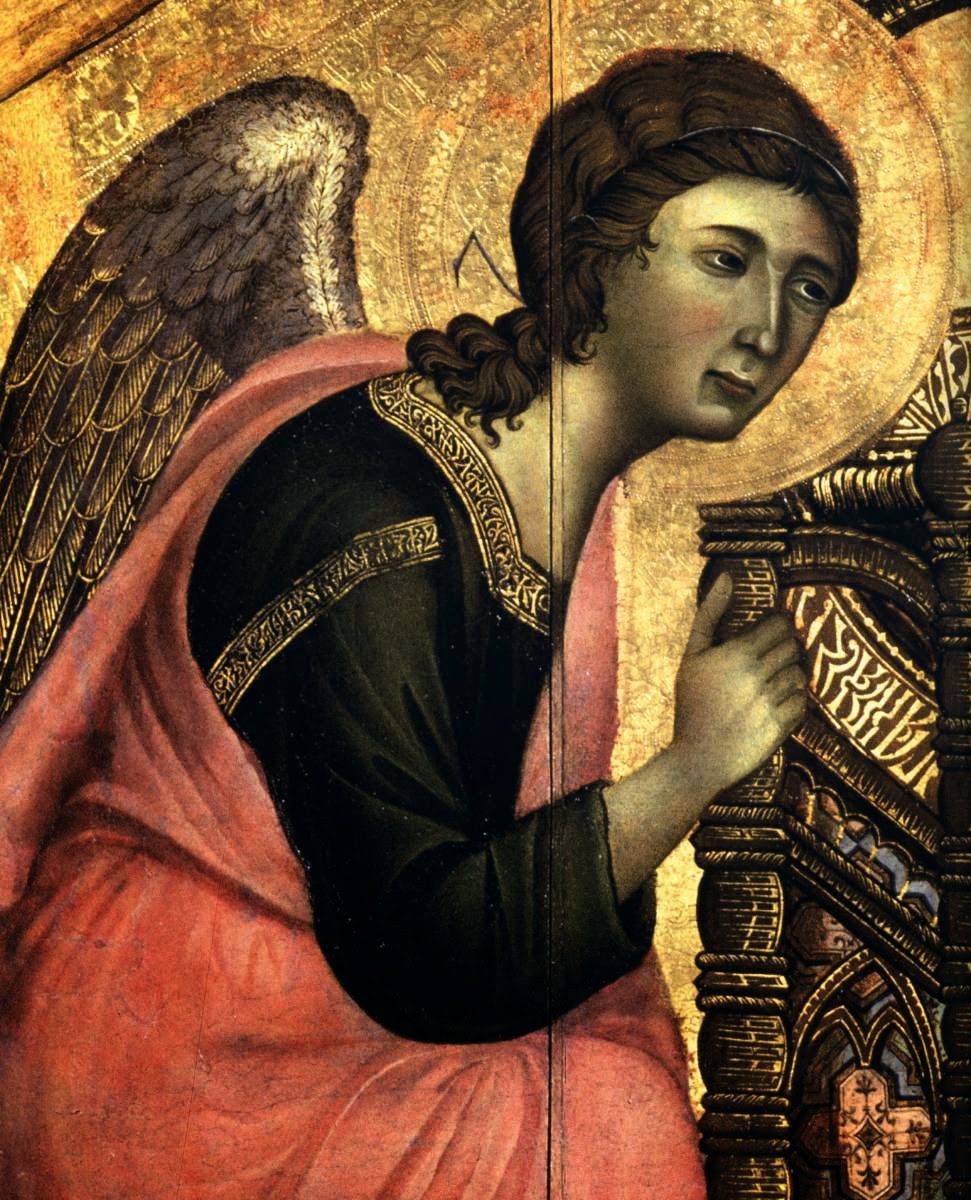
Rucellai Madonna (detail: Angel), by Duccio di Buoninsegna.
Tempera on wood, 1285; Galleria degli Uffizi, Florence.

"The divine essence is life"

"CREATURES are said to be in God in a twofold sense. In one way, so far are they are held together and preserved by the divine power; even as we say that things that are in our power are in us. And creatures are thus said to be in God, even as they exist in their own natures. In this sense we must understand the words of the Apostle when he says, "In Him we live, move, and be"; since our being, living, and moving are themselves caused by God. In another sense things are said to be in God, as in Him who knows them, in which sense they are in God through their proper ideas, which in God are not distinct from the divine essence. Hence things as they are in God are the divine essence. And since the divine essence is life and not movement, it follows that things existing in God in this manner are not movement, but life."

~St. Thomas Aquinas: Summa Theologica, I, Q. 18, A. 4, ad 1.

Tuesday, September 30, 2014

Garrigou-Lagrange: On Angels

Angelic nature, knowledge, will, merit and demerit from Reality: A Synthesis of Thomistic Thought by Reginald Garrigou-Lagrange 

Chapter 23: Angelic Nature And Knowledge

1. Nature Of Angels

St. Thomas [596] teaches clearly that the angels are creatures purely spiritual, subsistent forms without any matter. Scotus says they are composed of form and incorporeal matter, without quantity, because, being creatures, they must have an element of potentiality. The Thomistic reply runs thus: This potential element is first the angelic essence, really distinct, as in all creatures, from existence. Secondly, the real distinction between person and existence, between quod est and existence. Thirdly, real distinction of substance from faculties, and of faculties from acts. All these distinctions are explicitly formulated by St. Thomas himself. [597].

From their pure spirituality St. Thomas concludes that there cannot be two angels of the same species, because the only principle by which a substantial form can be individualized is matter, matter capable of this quantity rather than any other. Thus, to illustrate, two drops of water, perfectly similar, are by their matter and quantity two distinct individuals. But angels have no matter. [598].

Scotus, on the contrary, since he admits a certain kind of matter in the angels, maintains also that there can be many angels of one and the same species. Suarez, in his eclecticism, admits this conclusion of Scotus, although he sides with St. Thomas in maintaining that the angels are purely spiritual and immaterial beings. Thomists reply: if the angels are purely spiritual, you can find in them no principle of individuation, no principle capable of multiplying within one and the same species.

Form unreceived in matter, they say with St. Thomas, is simply unique. Whiteness, for example, if conceived as unreceived in this or that white thing, would be one and unique. If you deny this, then you simultaneously deny the principle which demonstrates the unicity of God, the principle, namely, which St. Thomas thus formulates: [599] Existence unreceived is necessarily subsistent and unique.

2. Angelic Knowledge

There are three orders of knowledge: human, angelic, divine. The object of knowledge in general is intelligible reality. The proper object of human intelligence is the intelligible being of sense objects, because the human intellect has as its proportioned object the lowest order of intelligible reality, the shadowy reality of the sense world. By opposition, then, the proper object of angelic intelligence is the intelligible reality of spiritual creatures. Hence, the proper intelligible object of each particular angel is that angel's own essence, just as God's proper intelligible object is His own divine essence. [600].

This position granted, let us see its consequences. The human idea, by which man knows, is an abstract and universal idea, drawn forth, by the intellect agent, from particular sense objects. But the angelic idea, not being drawn from external sense objects, is a natural endowment of the angelic intellect, infused into it by God at the moment of creation. Hence the angelic idea is at once universal and concrete. The angel's infused idea of the lion, say, represents not only the nature of the lion, but all individual lions that either actually exist or have in the past been objects of the angel's intellect. Angelic ideas are thus participations in God's own creative ideas. Infused ideas, then, which Plato and Descartes falsely ascribed to men, are, on the contrary, an angelic characteristic.

Thus these angelic ideas, at once universal and concrete, represent whole regions of intelligible reality, and each angel has his own distinctive suprasensible panorama. The higher the angel, the stronger is his intelligence and the fewer are his ideas, since they are more rich and universal. Thus, with ever fewer ideas, the higher angels command immense regions of reality, which the lower angels cannot attain with such eminent simplicity. [601] A human parallel is the sage, who, in a few simple principles, grasps an entire branch of knowledge. The stronger is the created intellect, to say it briefly, the more it approaches the preeminent simplicity of the divine intellect.

A further consequence. The nature of his ideas, at once universal and concrete, make the angel's knowledge intuitive, not in any way successive and discursive. He sees at a glance the particular in the universal, the conclusion in the principle, the means in the end. [602].

For the same reason his act of judging does not proceed by comparing and separating different ideas. [603] By his purely intuitive apprehension of the essence of a thing, he sees at once all characteristics of that essence, for example, he simultaneously sees all man's human and created characteristics, for instance, that man's essence is not man's existence, then man's existence is necessarily given and preserved by divine causality. [604].

Why this immense distance between angel and man? Because, seeing intuitively, the angel sees without medium, as in clearest midday, an immensely higher object, sees the intelligible world of spirits, whereas man's intellect, the most feeble of all intellects, having as object the lowest order of intelligibility, must be satisfied with twilight glances into the faint mirror of the sense world.

A further consequence is that the angel's intuitive vision is also infallible. But while he can make no mistake in his natural knowledge, he can deceive himself in the supernatural order, on the question, for example, whether this or that individual man is in the state of grace. Likewise he may deceive himself in forecasting the contingent future, above all in attempting to know the future free acts of men, or the immanent secrets of man's heart, secrets which are in no way necessarily linked with the nature of our soul or with external physical realities. The secrets of the heart are not fragments of the material world, they do not result from the interplay of physical forces. [605].

Contrary to this view, Scotus holds that the angel, though he has no sense faculties, can still receive ideas from sense objects. This view arises from his failure to distinguish intellects specifically by their proper and proportioned object. Thus he goes on to say that, had God so willed, the unmediated vision of the divine essence would be natural to both angels and men. Thus the distinction between uncreated intelligence and created intelligence is, for Scotus, a distinction not necessary, but contingent. A fortiori, then, he denies any necessary distinction between the proper object of the human intellect and that of the angelic intellect.

Scotus further denies that the ideas by which higher angels know are less numerous and more universal than those of lower angels. Perfection of knowledge, he says, derives less from the universality of ideas than from their clearness and brightness. Here Thomists distinguish. In the empiric order, yes, clearness does not depend on the universality of ideas. But in the order of perfection, in the order of higher principles, themselves concatenated with the supreme principle—in this order doctrinal clearness most certainly depends on the universality of its ideas.

Scotus holds also that the angel can know discursively, can engage in reasoning, a view which notably depreciates the perfection of the pure spirit. On the other hand, he holds that the angel can know, naturally and with certitude, the secrets of man's heart, though God, he adds, refuses this knowledge to the demons.

Suarez, again eclectically, admits with St. Thomas that the angelic ideas are innate, but holds, with Scotus, that the angel can use reasoning, and can be mistaken regarding the characteristics of the object he knows.
__________________________________________

Chapter 24: The Angelic Will

St. Thomas seeks to understand the angelic will by the object to which that will is specifically proportioned. Scotus insists rather on the subjective activity of that will.

Studying the object of the angelic will, St. Thomas concludes that certain acts of that will, though voluntary and spontaneous, are nevertheless not free, but necessary, by reason of an object in which the angelic intelligence sees no imperfection, but perfect happiness. As regards angelic freedom of will, he holds that angelic choice, like human choice, is always determined by the last practical act of judgment, but that the act of choice by accepting that judgment makes it to be the last. Scotus, on the contrary, holds that freedom belongs essentially to all voluntary acts, and that free choice is not always determined by the last practical act of judgment. On this point Suarez follows Scotus. Against them Thomists invoke the following principle: "If nothing can be willed unless it be foreknown as good, then nothing can be here and now preferred unless it be here and now foreknown as better." [606] In other words, there can be no will movement, however free, without intellectual guidance, otherwise we confound liberty with haphazard, with impulse, which acts necessarily and without reflection. Here lies the source of the chief doctrinal divergences concerning the angelic will.

St. Thomas teaches that the objects which the angel loves, not freely, but necessarily, at least necessarily as regards specification, are, first, his own happiness, second, himself, third, God as author of his nature, the reason being that in these objects he can find nothing repulsive. [607] Hence it is more probable that the angel cannot, at least not directly and immediately, sin against the natural law, which he sees intuitively as written into his own essence. [608] Yet the demons, in sinning directly against the supernatural law, sin indirectly against the natural law which prescribes that we obey God in everything He may command.

Further. If the angel sins, his sin is necessarily mortal, because, seeing end and means with one and the same intuitive glance, he cannot be disordered venially, i. e.: in regard to means, without previous mortal disorder in regard to his last end.

Again, the sin of the angel is irrevocable, and hence irremissible. In other words, since the angel chooses with perfect knowledge after consideration, not abstract, discursive, successive, but intuitive and simultaneous, of all that is involved in his choice, he can no longer see any reason for reversal of his choice. Hence arises the demon's fixed obstinacy in evil. Nothing was unforeseen in his choice. If we were to say to him: "You did not foresee this," he would answer, "Surely I foresaw it." With fullest knowledge he refused obedience, and refuses it forever in unending pride. Similarly the choice of the good angel is irrevocable and participates in the immutability of God's free act of choice. [609] St. Thomas cites approvingly the common expression: Before choice the free will of the angel is flexible, but not after choice. [610].

Scotus admits none of these doctrines. No act of the angelic will is necessary, not even the angel's natural love of his life or of the author of life. The will can sin even when there is no error or lack of consideration in the intellect, because free choice is not always conformed to the last practical judgment. The first sin of the demon is not of itself irrevocable and irremissible. The demons, he says, committed many mortal sins, before they became obstinate in evil, and could have repented after each of those sins. And their obstinacy itself he explains extrinsically, as due to God's decree that, after a certain number of mortal sins, He would no longer give them the grace of conversion. On these points Suarez follows Scotus, since he too holds that free choice is not always conformed to the last practical judgment. But he does not explain how free choice can arise without intellectual direction. Thomists repeat: Nothing can be willed unless here and now foreknown as better.

Contrast shows clearly that St. Thomas has a higher conception of the specific distinction between angelic intelligence and human intelligence than have Scotus and Suarez. Faculties, habits, and acts are proportionally specified by their formal objects. To this principle, repeatedly invoked in the Summa, Thomism insistently returns.

This treatise on the pure spirit, on intuitive knowledge, lies on a very high level. Its conclusions on the angelic will are faithful to the principle: nothing willed unless foreknown as good. From the speculative point of view this treatise is a masterpiece, a proof of the intellectual superiority of the Angelic Doctor, an immense step forward from the Sentences of Peter the Lombard. Scotus and Suarez did not maintain this elevation, did not see the sublimity, intellectual and voluntary, of the pure spirit as contrasted with the lowly intellect and will of man.
__________________________________________

Chapter 25: Angelic Merit And Demerit

St. Thomas holds that all the angels were elevated to the state of grace before the moment of their trial, because without sanctifying grace they could not merit supernatural happiness. With this doctrine Scotus and Suarez agree. They also agree in saying that most probably all angels received this gift at the moment of their creation. All three teachers, following St. Augustine, [611] hold that the revelation had the obscurity of faith. [612] The three agree also in saying that after their trial the good angels were immovably confirmed in grace and received the beatific vision, while the wicked angels became obstinate in evil. But, notwithstanding this agreement, there remain three problems concerning the state of the angels before and during their trial. On these problems St. Thomas again differs widely from Scotus and Suarez.

1. Natural Happiness

St. Thomas holds that at the very moment of their creation the angels received all their natural perfection of spirit and their natural happiness, because their innate knowledge proceeds instantaneously, without succession, from faculty to act. Hence, at the very moment of creation, they have perfect intuition of their own nature, and in that nature as mirror they know God as author of that nature, on which their own natural law is inscribed. Simultaneously also in that same moment they know all other angels, and have instantaneous use of their own infused ideas.

Here Scotus and Suarez do not follow St. Thomas. They deny, first, that angels had natural beatitude from the moment of creation. They hold, secondly, that the angels could, from that first moment, sin against the natural law directly and immediately. In reply, Thomists simply insist that pure spirits must from their first moment of creation, know their own selves perfectly as pure spirits, and hence know their own nature as mirror of the Author of that nature, and consequently must love that Author as the source of their own natural life, which they necessarily desire to preserve.

2. Instantaneous Choice

At the very moment of creation, so St. Thomas, the angels could not sin, but neither could they fully merit, because their very first act must be specially inspired by God, without their own self-initiated interior deliberation. But at the second instant came either full merit or full demerit. The good angel after the first act of charity, by which he merited supernatural beatitude, was at once among the blessed. [613] Just as immediately the demons were repudiated.

Hence, with St. Thomas, we must distinguish three instants in the life of the angel: first, that of creation; second, that of merit or demerit; third, that of supernatural beatitude [614] or of reprobation. We must note, however, that an angelic instant, which is the measure of one angelic thought, may correspond to a more or less long period of our time, according to the more or less deep absorption of the angel in one thought. An analogy, in illustration, is that of the contemplative who may rest for hours in one and the same truth.

The reason for the instantaneousness of the divine sanction after the first angelic act, fully meritorious or fully demeritorious, has been given above. Angelic knowledge is not abstract and discursive like ours, but purely intuitive and simultaneous. The angel does not pass successively, as we do, from one angle of thought to another. He sees at once, simultaneously, all the advantages and disadvantages. Hence his judgment once made is irrevocable. There is nothing he has not already considered.

What kind of sin was that of the demons? Pride, says St. Thomas. [615] They chose as supreme purpose that which they could obtain by their natural powers, and hence turned away from supernatural beatitude, which can be reached only by the grace of God. Thus, instead of humility and obedience, they chose pride and disobedience, the sin of naturalism.
Scotus and Suarez, as we have seen, since they hold that the angelic knowledge is discursive and successive, maintain likewise that the angel's practical judgment and act of choice are revocable, but that after many mortal sins, God no longer gives them the grace of conversion.

3. Source Of Angelic Merit

St. Thomas holds that the essential grace and glory of the angels does not depend on the merits of Christ, because "the Word was made flesh for men and for our salvation." Christ merited as Redeemer. Now the essential grace of the angels was not a redemptive grace. [616] And their essential glory, he says elsewhere, [617] was given them by Christ, not as Redeemer, but as the Word of God. Yet the Word incarnate did merit graces for the angels, graces not essential but accidental, to enable them to cooperate in the salvation of men.
Scotus again differs. Since the Word, he says, also in the actual plan of Providence, would have become man even if man had not sinned, we should hold that Christ merited for the angels also their essential grace and glory. And Suarez holds that Adam's sin was the occasion and condition, not of the Incarnation, but of the Redemption. Even if man had not sinned, he says, the Word would still perhaps have become incarnate, but would not have suffered. Hence, he concludes, Christ merited for the good angels their essential grace and glory, and is therefore their Savior.

Thomists reply that Christ is the Savior only as Redeemer. But for the angels He is not Redeemer. Further, they reflect, if the angels owed to Christ their essential glory, the beatific vision, they would, like the just of the Old Testament, have had to wait for that vision until Christ rose from the dead.

Let us summarize this Thomistic treatise on the angels. The main point of difference from Scotus and Suarez lies in the specific difference between angelic intelligence and human intelligence, a difference that depends on their respective formal object, his own essence for the angel, for the man the essence of the sense world known by abstraction. Hence angelic knowledge is completely intuitive. From this position derive all further conclusions of St. Thomas, on angelic knowledge, will, merit, and demerit. This Thomistic [618] conception of pure spirit is much higher than that of Scotus and Suarez. This treatise also throws much light on the following treatise where St. Thomas, in studying the nature of man, dwells on the quasi-angelic state of the separated soul.

A last remark. St. Thomas, as he proceeds, corrects the grave errors of the Latin Averroists, who looked upon all immaterial substances as eternal and immutable, as having a knowledge eternally complete, as depending on God, not for creation, but only for preservation. [619].
__________________________________________

ENDNOTES

596. 596 Ia, q. 50, a. 1, 2.
597. Ia, q 54, a. 1, 2, 3.
598. Ia, q. 50. a. 4.
599. Ipsum esse irreceptum est subsistens et unicum. Ia, q. 7, a1; q. 11, a. 3.
600. Ia, q. 12, a. 4.
601. Ia, q. 55, a. 3.
602. Ia, q. 58, a. 3.
603. Componendo et dividendo.
604. Ia, q. 58, a. 4.
605. Ia, q. 57, a. 3, 4, 5.
606. Nihil volitum nisi praecognitum ut conveniens, et nihil praevolitum nisi praecognitum ut convenientius hic et nunc.
607. Ia, q. 60, a. 5.
608. Ia, q. 63, a. 1, ad 3;De malo, q. 16, a. 3.
609. Ia, q. 62, a. 4, 5; q. 63, a. 5, 6. 
610. Ia, q. 64, a. 2.
611. De civ. Dei, XII, 9. Cf. Ia, q. 62, a. 3.
612. Ia, q. 64, a. 1, ad 4.
613. Angelus post primum actum caritatis quo beatitudinem (supernaturalem) meruit, statim beatus fuit. Ia, q. 62, a. 5.
614. This instant is already the one unique instant of eternity.
615. Ia, q. 63, a. 3616 Cf. De ver..: q. 29, a. 7, ad 5.
617. IIIa, q. 59, a. 6.
618. See Cajetan, Banez, John of St. Thomas, the Carmelites of Salamanca, Gonet, and Billuart.
619. Cf. Mandonnet, Siger de Brabant et l'Averoisme latin au XIIIe siecle, and ed.: Louvain, 1908-610. Introd. and chap. 6; also Denifle, Chartularium univ. parisien.: I, 543.

Share This